
In the world of digital window graphics, the concept of clarity can be seen through two different lenses.
- Printed graphics need to be clear. Text is easy to read. Crisp designs. Colors bright. Logos is instantly recognizable.
- The finished pieces need to have a predetermined level of optical clarity. When they are installed, can you see through the window, or do they apply a level of privacy through their opaqueness?
Optical clarity is an important factor in a window film design. To help design teams achieve the levels of clarity needed, there are four things every designer should know about optical clarity in window films.
4 Things Every Designer Should Know About Optical Clarity
Optically clear window film can be used for design and branding, as well as being a practical architectural element in a space. Understanding your location and the “requirements” it holds early in the specification process can help save a design team needless hours of rework.
In addition to understanding the intended flow of the physical space, designers should take these four items into consideration before starting.
1. The Technical Side of Optical Clarity
There are four technical factors of window film that can impact its optical clarity.
- Total Transmission (%T) - This is how much light can pass through a material. For strong optical clarity, you want this to be at 90% or higher.
- Haze (%) - A window film’s haze percentage refers to the way that it scatters light. A lower number means you will have sharper graphics.
- Clarity (%) - If there is a window film separating you and another object, how focused that object appears when looking through the film gives you a clarity number. High-end films provide clarity that often exceeds 95%.
- Gloss (60°) - The reflectivity of a surface is described as its gloss. Films with a higher degree of gloss (75-95 GU) typically have a higher level of clarity.
Understanding these numbers will help you select a window film that meets both your clarity and design needs.
2. Optical Clarity and Visual Perception
The optical clarity of a window film installation can help a person’s visual perception of its design. That can come from the fact that when it comes to optical clarity, it’s not an all-or-nothing situation. A designer can use the properties of a high-clarity window film to call attention to specific aspects of the design.
3. Optical Clarity as an Architectural Element
When creating a design for a digital window graphic, it is important to understand the way that light will enter the space.
- If you are covering the windows of a conference room with an outside wall, your design may need to utilize deeper colors and broader designs in the patterns to account for a higher level of brightness.
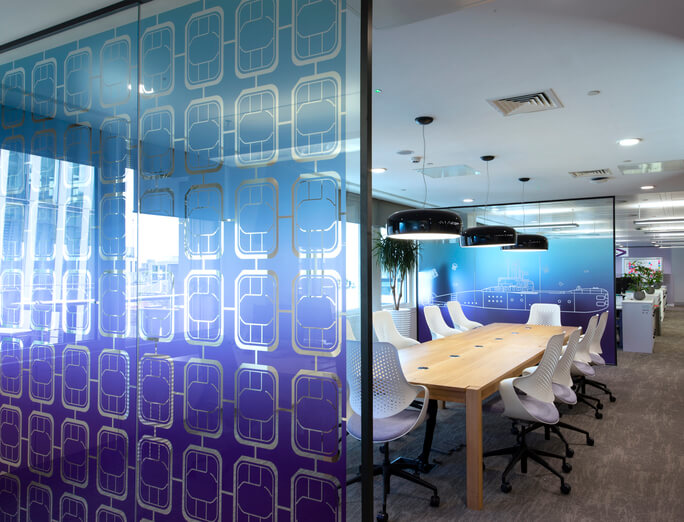
- If the graphic is covering a space between two indoor areas, and you want people to slightly see through the design to get a sense of what’s in the other area, you’ll need to account for how indoor lighting plays into that.
- If it’s being used in an area where privacy is paramount, keeping the optical clarity to a minimum is important.
4. A Materials’ Impact on Optical Clarity
Even designs that take all of an area’s environmental factors into play to create an ideal level of optical clarity will be ineffective if they are not matched to the right window film material. If you are using traditional polyester and recycled PET, you can generally expect to have 100% optical clarity, while vinyl is at a mid-range level. This is due to a number of inherent factors in the material. For example, traditional polyester and recycled PET have minimal shrinkage, while the shrinkage in vinyl is variable when the cast is minima,l but high when it is calendared.
LINTEC of America can help you match your needs for clarity with your goals of working sustainably with 100% recycled PET films from the ECO Series. These optically clear polyester window films offer UV and scratch resistance and 100% optical clarity while helping you meet LEED standards. With recycled PET you’ll get the performance you expect from traditional substrates with a significantly lower environmental impact.
When Clarity is Key
Utilizing optically clear window film is not just a design choice; it can have strong practical application value as well.
|
Location |
Is Optical Clarity Needed |
|
Branded Interiors |
Design choices for interior glass can reflect the company’s identity and culture. Companies that are more “open” should use materials like an optically clear PET film, which supports their brand ethos. |
|
Healthcare Spaces |
When designing for healthcare locations, HIPPA laws must be followed and patient confidentiality respected. This means high-clarity window films should allow light through but should otherwise stop people from becoming viewers. |
|
Conference Rooms |
A moderate degree of optical clarity can be a benefit. It allows others in the office to see if a space is occupied, but not so much that it invites intrusion into sensitive meetings. |
|
Retail |
A full degree of optical clarity is preferable as it opens a retail space up to the outside and, in doing so, invites people to enter. |
Lintec - The Clear Choice for Optical Clarity
By following the suggestions provided here, designers can ensure that their window graphics bring the needed level of optical clarity to a space. And when those designs are matched with LINTEC’s line of ECO Series of recycled polyester films, you will achieve sustainability goals without trading performance standards.
Are you ready to realize 100% optical clarity in your next project? Reach out to the digital window graphic experts at LINTEC of America.